
Purpose
This page provides details regarding the additional data collection aspect of the TMS protocol. The additional data collection is performed once MEP status has been determined.
Overview
The additional data collection involves collecting 10 “keeper” frames at each of three stimulus intensities for patients classified as MEP+ at ≤ 90% MSO.
A full version of the TMS protocol including the additional data collection as point 10a-g can be downloaded from here.
10. Additional data collection of 30 “keeper” frames without biological and non-biological noise. If the patient is MEP+ at ≤ 90% MSO then complete a brief assessment of excitability.
-
- Once you have determined the participant is MEP+, spend a minute hotspotting to see if there’s a more optimal scalp site for eliciting MEPs in the paretic FDI muscle. If MEPs were only observed in the paretic ECR at the initial stimulator intensity that produced MEPs then use the optimal scalp location for the ECR.
- Once you find your hotspot you will need to either not move and keep the coil in that position when recording the 30 “keeper” frames, or mark the position on the patient’s scalp. You can use a soft-tipped marker to put a dot on their scalp at the front of the coil, or on a small piece of tape on their hair. It’s important to keep the coil at a consistent position and angle for all additional data collection.
- Deliver 10 consecutive stimuli at the initial stimulus intensity where MEPs are first observed.
- Decrease the stimulus intensity by 5% MSO and deliver another 10 stimuli. This is recorded on the source document as stimulus intensity A, which is 5% MSO below the initial intensity.
- Increase the stimulus intensity by 15% MSO and deliver another 10 stimuli. This is recorded on the source document as stimulus intensity B, which is 10% MSO above the initial intensity.
- If any biological or non-biological noise arises on the EMG traces you will need to pause data collection to eliminate the noise, and repeat any stimuli for traces contaminate by noise, so there are 10 noise-free “keeper” frames at each of the three stimulus intensities. For example, the 10 “keeper” frames for intensity B might be frames 80-83, 85-86, and 88-91 because significant non-biological noise was present in frames 84 and 87.
- If it is not possible to eliminate biological or non-biological noise then still complete the additional data collection and note this in the comments box on the source document.
Example
The participant’s right upper limb is paretic and was tested.
Lucy van Pelt is an OT and she is the TMS Operator for the session, and the TMS Assistant was Sally Brown who is a nurse. The participant was partially supine in their bed at the time of testing.
The patient had already provided written informed consent, and their TMS Safety Screening Checklist was completed with no contraindications to TMS present. On the day of TMS testing the patient’s physician Dr. Lowry confirmed testing was still appropriate.
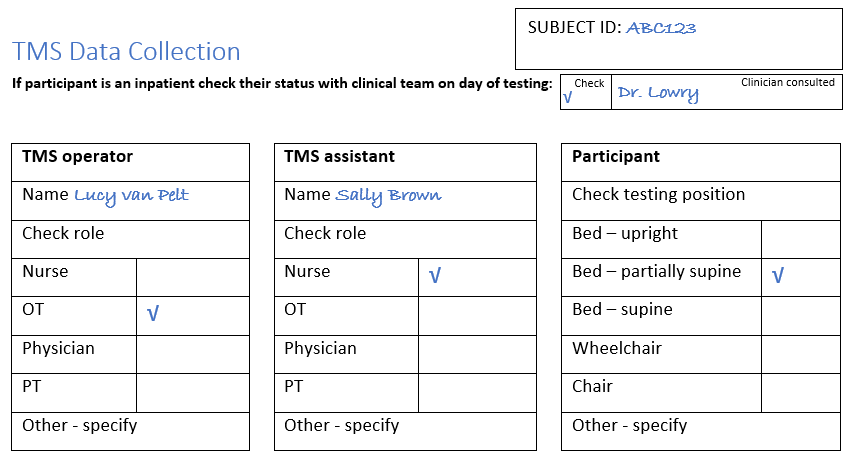
Lucy and Sally performed the VERIFY TMS protocol from steps 1-9, and small MEPs in the ECR EMG trace were present with 60% stimulation intensity. Sally recorded the patient’s MEP status as MEP+ on the source document.


Now that Lucy had found the initial stimulus intensity that produced MEPs, she quickly repositioned the coil to find the best coil position for eliciting MEPs in the ECR. She did this by moving the coil in half-inch steps from the starting position. Once she identified the best position that most consistently produced MEPs in the ECR she kept the coil in that position for the additional data collection.
Lucy then delivered 10 stimuli at this initial intensity of 60%. Sally made sure the 10 frames were free from biological and non-biological noise and wrote down the numbers for these 10 frames, which were frames 32-41. This is shown in the image below. For MEGA-TMS systems the frame number can be found on the left hand side of each trace, where there’s a numeral followed by a comma and the name of the muscle. The frame numbers can also be found in the panel on the right of the screen, where the traces are listed along with the stimulus intensity used. Assistance for finding the frame number on MEGA-TMS machines can be found here.
Keeping the coil in the same place, Lucy then recorded another 10 “keeper” frames at the A intensity, which is the initial intensity minus 5%. These were numbered as frames 42-48 and 50-52 as shown below. Frame 49 was not included as a “keeper” frame because it was caused by Lucy accidentally discharging the TMS coil while it was not on the patient’s head.
Lucy then recorded a final 10 “keeper” frames at the B intensity, which is the initial intensity plus 10%. Notice in the example below that the last EMG trace at the A intensity (55%) was number 52 and the first EMG trace at the B intensity (70%) was number 55. So what happened to trace numbers 53 and 54? These traces were contaminated with biological noise because there was a low level of muscle activation in the ECR EMG trace. Sally noticed this and helped by asking the patient to relax their shoulders and arms, and gently repositioned their hand and arm. This eliminated the biological noise, and so trace 55 was the first “keeper” frame at the B intensity. Muscle activation noise was also present in frames 59, 61 and 62 so Lucy continued stimulating until 10 “keeper” frames free from noise were obtained and their numbers were recorded.
Lucy noted FDI MEPs were elicited at the B intensity of 70% MSO even though none were present at the initial intensity of 60% that elicited ECR MEPs. For the “check muscles with at least 1 MEP” she checked “both” because MEPs had been elicited in both muscles regardless of the intensity they were first elicited.

In a separate example, ECR MEPs were elicited at 100% stimulator intensity while the participant was at rest. No additional data collection was performed because it’s not possible to deliver stimulations at the calculated B intensity of 110% stimulator intensity.

If you have any questions about the additional data collection then please email verify.study.tms@gmail.com.